Search

A Few Short Words

Tag

album

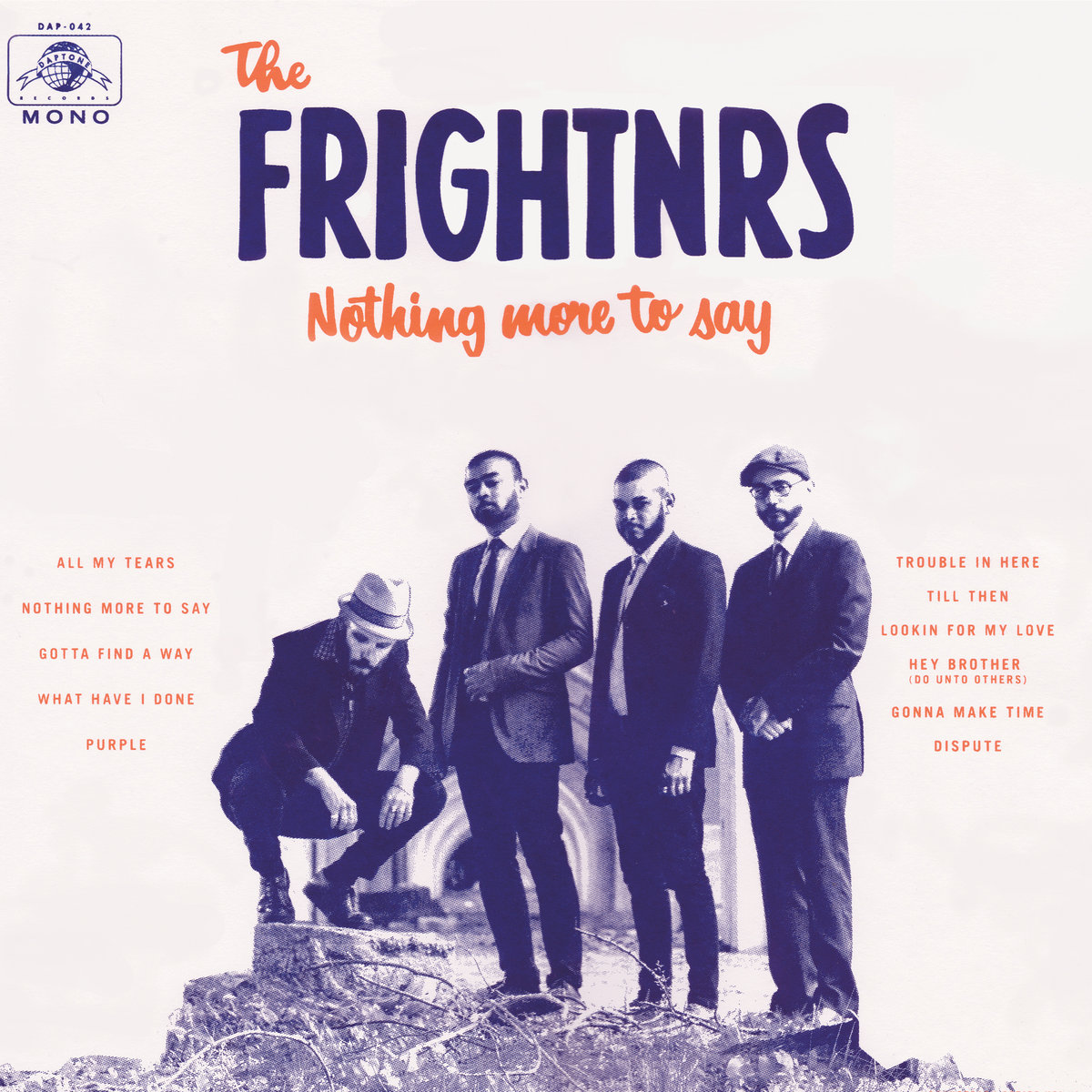
The Frightnrs: Nothing More To Say

After a pair of EP’s released some years previously, The Frightnrs (who sadly hold no connection to the seminal film) have dropped their fist full studio album, Nothing More To Say, an eleven track trek into a trio of categories: irie, love, and the irie trouble with love.

This Queen’s quartet are renowned for their low-slung reggae vibes, deceptive falsetto vocality, and an avoidance of the clichés that (arguably) hallmark the genre. While the group does sidestep many of the regular trappings, like herbal etiquette for example, they seem to have taken that step into one confined direction. Sure, there are derivations here and there, a tempo change or chittering harmonica, an ambiguous duet or harmonic stack, but none of it ever really explodes. It’s almost as though the tracks had their vibe levels capped at Sunday afternoon beer garden.

In a dip dapping nod in Daptone’s direction, there are a couple of cheeky covers thrown in for good measure, Bob & Gene’s ’67 classic Gotta Find a Way and Saun and Starr’s more recent Gonna Make Time, but both are so fully indoctrinated into the irie proceedings that they feel indistinguishable from the rest. Good or bad, it’s certain to spark something in eagle-eared fans, and it definitely speaks to the organ-grinding mastery they have over the material.

The Frightnrs are clearly a tight and harmonious outfit, their dedication to a certain style of sound is admirable and on-point, almost to a fault, but this is undoubtedly a record that should be treasured by lovers of reggae, soul seekers, and anyone else that might simply enjoy a mild to moderate afternoon of decanted calypso chemistry. The rest of us can just sit back and wonder if naming a debut Nothing More To Say was a literal mistake or an allegoric accident.

Beck: Morning Phase

Breaking out of the fringes during the grunge revolution of the nineties, Beck came to the fore with a style full of incisive anti-folk sentiment and satirical experimentation. Raised by avant-garde parents in the aftermath of the pop-art movement, his was a voice that was sharp, clear and easily heard among the forefathers of the indie uprising.

Beck’s new album, Morning phase, was built as a companion piece to the now twelve year old Sea Change, an album that was deeply personal yet culturally irreverent in a relevant way. Unfortunately, the companionship offered by Morning Phase is largely empty, like a conversation with an old friend who just waits for their turn to talk and then has nothing to say. In fact, by anchoring it to the past so explicitly it’s easier to see how little progress has been made. It becomes a way of emulating what has gone before without having to gain anything from it.

There’s a pervasive feeling that nothing has been able to make Beck happy in the time that has gone by. Passively clingy, the voices of indie pioneers echo out of each track as if from some deep backwater canyon. The compositions are littered with limpid string arrangements, banjo and piano melodies that are pleasantly mellow, if not a little maudlin, it actually feels quite unfortunately shallow. It could simply be the direction of the thing, being a more inward facing undertaking than we’re used to receiving, but there’s a sad sense of surrender throughout the album, an aged acquiescence living inside  it that feels a little selfish.

The problem is that most of it feels too intimate to be connected with. The songs seem to be written exclusively for him or for someone dear departed, a message created specifically for someone other than you and then delivered with frustratingly consistent insularity. There’s no room made for engagement and no hint that it might even be welcome.

Morning Phase might be a great love letter for it’s intended, but for everyone else there’s not even the perverse satisfaction of reading a strangers diary, just empty sentiment without calibration.

Sampa The Great: Weapon Chosen

Sampa The Great is pretty darn good. Straight outta Sydney by way of Zambia, she dropped her first mixtape, The Great Mixtape, back in September and since then she’s been getting all the right kinds of attention from the boys in the biz. She deserves it too, ‘cause that thing is legitimate dope.

Her latest release, Weapon Chosen, is a direct response to Hiatus Kaiyote’s request for a remix, like they heard what she was putting down and said, do you reckon you can make us better? Well, she probably could, but instead of taking what they laid out and adding a little R’n’B wah wah, or just spitting rhymes all over it, she’s created a diacritical response that completely negates the original meaning in the best possible way.

Running over six tracks and one literal second past eleven minutes, the EP, mixtape, rework or whatever, is sort of like grappling with one side of an academic conversation, like a physics professor explaining string theory with bananas. It probably shouldn’t work, but it absolutely does, and forms a measured, intelligent retort to stimuli outside of the usual fieldwork.

Sampa’s style is something like neo-tribalism infused with the kind of 3030 future beats that dub drivers have been piloting in circles for years. Yet, she’s not beholden to any of it. That’s what’s really great here. Everything that should be pastiche or passé is positively unique and seamlessly produced. Despite the samples and the origin, the sound here is absolutely her own, and that’s even better than the fact that we get to claim her as Australian, because individuality is becoming an increasingly rarefied creature in the modern age.

If you have eleven minutes in your day, you should listen to this release. If you don’t, well then you should reprioritise some shit and still listen to it. This side of autoerotica, it’s the best use of that time you’re likely to find.

Radiohead: A Moon Shaped Pool

Radiohead are only making records for Radiohead now and that’s totally fine, they’ve climbed the pantheon and earned their right to sit around peeling grapes. It’s probably not as relaxing as all that though, Thom Yorke has obviously been feeling a tonne of things lately and it’s leaking out all over the album. Well, it practically is the album.

A Moon Shaped Pool runs deep with self-referential allusions, isolation and intimacy. There’s something deeply reflective about it, as though they’re looking back on their lives, their loves, their memories; looking back at the product of the past they made and saying, this is how we feel about it now and whatever its value is, it’s grown tiresome. The album itself nearly feels exhausted, as though the effort of conception and sheer existence were completely draining. The attitude is almost listless, certainly wistful, and achingly despondent, but the sound isn’t; no, never the sound, though the pathos behind it this time out, the creative drive, seems to be a slow shaking of the head and a solitary tear leaking from rheumy eyes.

Even at its most passionate, like the piercing and relentlessly dire strings of Burn The Witch, or the escalating electrical pulse that defines Ful Stop’s spine, there’s a deceptive and distorted quality to it, something deeply at odds with the clear beauty of it all. It’s like looking into the very thing it’s named for, gossamer radiance in a rippling shimmer that’s both reflective and original, and feeling sad that it’s so lovely.

There are times and tracks that feel almost like listening to someone recount a memory they don’t really have or can’t quite recall. The Numbers plays as Romeo and Juliet by way of Paranoid Android; Identikit calls back to King of Limbs like a wilted Lotus Flower and despite the upbeat percussion, almost grandiose choral swell, and sharp synth deviations, almost typifies the unexpectedly somber undercurrent of the album.

There’s enough room in A Moon Shaped Pool to dissect every piece and beat in order to dredge up the past they were built on, though it’s probably unnecessary. In many ways this is the ‘best of’ the group never made, one they actually have control over, and is a finer summation of their trajectory than any compilation could ever be. In the end though, the value of the album will be defined by your stock in Radiohead. ‘All this love will be in vain,’ Yorke tells us in Present Tense, but A Moon Shaped Pool will only show you what you ask to see.

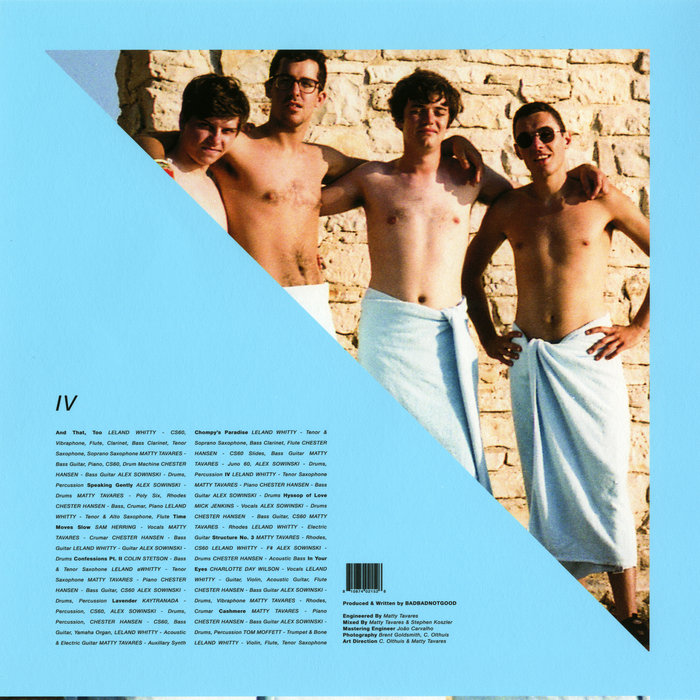
BADBADNOTGOOD: IV

IV was leaked more than a month in advance of its intended release and you could make an argument against piracy out of it, but you shouldn’t because it really says more about the fervour of the fans waiting desperately to wrap their paws around any new material the group could provide, illicitly gained or not. Fortunately for them and the group itself, IV is a formidable release that will have surely used that extra time on the (black bit) market to cement itself in the jazz pop psyche and earn back some of the lost clams that torrents allegedly claim.

The Toronto quartet (née trio) rolls out their latest release in a low key but distinctly BADBADNOTGOOD way. The opener And That, Too. is almost a sinister stakeout, a prelude waiting to pounce on the album’s remaining ten tracks. From there the album only gets more, well, moreish.

Besides the un-enumerated Sour Soul (a hip-hop heavy, jazz jape platform for Ghostface Killah), this is the first album for the boys that truly features featured guests. Certainly it’s the first with vocal accoutrement and definitively the first with Leland Whitty (a previously regular contributor) as an official BBNG boy. Without being in on the jam it’s hard to say what kind of impact this actually had on the sound of the album but in many ways it feels like a welcome mat, a softball entry into BBNG territory.

In part, IV feels like a best-of featuring new songs or, more fittingly, old ideas made fresh by new friends conversing. Each track is so smooth and subtly segued that you could easily travel from one end to the other without realising you took the trip at all, though, by holding a up a map of their previous meanderings you can start to recognise familiar landmarks, not distorted but reassessed by time, exposure, and the shifting perspectives garnered from experience.

The second track Speaking Gently, for instance, looks at III‘s Kaleidoscope, but softly, as though through the wistful, sepia lens of time, becoming, in many ways, a revisitation of the old by the new, intentions and perspectives charged by an almost ruminatory reflection, and it’s certainly not the only reminiscent riff or refrain to feature on the album.

What’s truly new, however, are the vocals, well, at least for the BBNG boys as they are. The accompaniment is used sparingly, spaced with an overarchingly perfect sense of timing, and only cements the group as purveyors of almost anachronistically classic composition. The first of the three vocal tracks, Time Moves Slow featuring Sam Herring, has a timeless slow jazz vibe and harkens towards a Bill Withers by Thelonious Monk blend that is inescapably engaging. The Mick Jenkins beat, Hyssop of Love, is a hip hop aside that embraces every complimentary cadence and In Your Eyes with Charlotte Day Wilson is simply a beautiful, soul ridden example of songcraft that could play anywhere between here and yesteryear.

IV is not III and maybe that’s a sad sentiment considering how incredible III really was, but IV comports itself with a maturity and reflectively joyful sobriety that previous BBNG offerings only ever hinted at. Fans of the group’s previous efforts may not have their socks blown off, merely removed, darned and re-administered, and newcomers may only hear the smooth tinkling of soft background soul. However, those who listen, learn, and love, will find an album full of unadulterated pleasure, albeit in a key that seems too soft to touch, though if you let it, you might just find yourself being touched back.

Create a website or blog at WordPress.com

Up ↑